








Business owner
Connect recovery priorities to revenue, delivery and the commitments your customers depend on.
The Digital Younger Dryas The journey
When the operating environment changes faster than your business, resilience becomes a growth decision. Understand your exposure. Protect your customer commitments.
Choose your role to prepare a question in chat. Edit it before sending.
Connect recovery priorities to revenue, delivery and the commitments your customers depend on.
Map dependencies and agree who owns controls before a platform change.
Make data reconciliation, integration permissions and rollback part of the delivery plan.
Understand how orders, account access and personal information are handled during change.
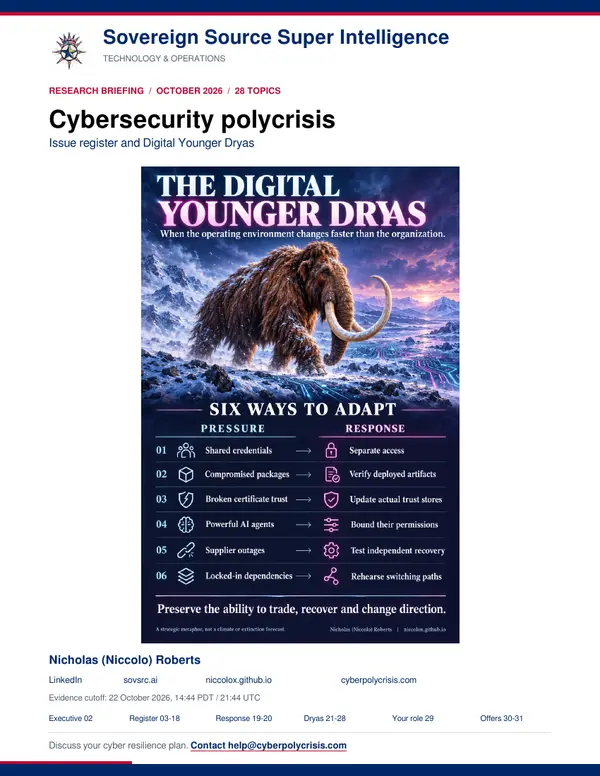
When access becomes suspect, containment can interrupt the automation that keeps a business moving. The Cyberpolycrisis report connects technical exposure to the orders, revenue and customer trust at stake.
PDF · About 7.7 MB · Direct download
Incidents, vulnerabilities, research and policy developments. Open a card for the evidence, scope and recommended actions.
Research edition
22 October 2026
Priorities are the report’s editorial assessments and depend on actual exposure. An asterisk marks especially conditional exposure. These records do not establish one coordinated campaign.
CERT-EU’s 21 October advisory describes two unauthenticated remote-code-execution vulnerabilities and identifies patched PHP branches. It says all web-serving installations need assessment, with Apache mod_php considered the highest-risk configuration. Application-level login controls do not remove a runtime vulnerability.
Google’s preliminary report attributes the London regional disruption to a power interruption in europe-west2-b, followed by regional failover and queuing effects. It records a six-hour-ten-minute incident spanning 19–20 October in US/Pacific time. This source establishes an availability event, not a cyberattack.
NorForge reports observing more than twenty exposed Cairn panels associated with suspected malicious operations, alongside apparently legitimate red-team activity. The observations show organised AI-assisted workflows. Panel counts, stated objectives and tool outputs are not interchangeable with independently verified victim counts.
The 20 October Federal Register notice describes a DHS exclusion and removal order for DeepSeek-related products in federal civilian procurement and information technology, including certain third-party implementations. It is a procurement and governance measure; the notice alone is not evidence that a particular private business has suffered a breach.
Microsoft’s 19 October guidance treats agents as active enterprise participants with identities, tools and permissions. It argues for controls across the agent’s environment and actions. This is a vendor security position, not a report that every AI agent is compromised or an independently measured rate of insider incidents.
Cloudflare reports compromise of private keys associated with eight eMudhra intermediate certificates and describes updates across client software and trust configurations. The issue concerns certificate validation. A browser update, server certificate replacement and application runtime update are different remediation tasks.
OpenCode’s documentation confirms that workspaces can use customer-supplied provider API keys and that these requests are billed by the provider. The original incident statement linked in the PDF could not be retrieved during this pass. The dated report’s incident account is retained, but fresh scope or restoration claims are not independently confirmed here.
Lightning’s notice distinguishes Studio Platform services from GPU rental infrastructure and managed Kubernetes/SLURM services. It describes credential access, a platform access suspension and recommended review of connected third-party accounts. The notice remains an investigation statement, not a complete account-by-account exposure determination.
PingCAP’s notice describes stolen service-account credentials and copied internal data, including account, commercial and SQL-editor information. It separates confirmed information categories from unresolved customer-specific scope. Its production-system observations do not negate the separately described information exposure.
LiteLLM identifies affected PyPI wheels and Docker/GHCR artifacts, with registry-specific exposure windows. It says the official source tag lacks the malicious files and warns that starting Python, including pip, can retrigger the installed payload. Artifact identity and recovery order therefore matter.
Apple’s bulletin documents security fixes in iOS and iPadOS 26.7, released on 14 September 2026. That bulletin does not by itself verify the broader proximity-attack narrative in the report. The original research URL could not be retrieved during this pass, so this remains a qualified watch item.
PHP’s guidance describes limited source backports for 7.4, 8.0 and 8.1 while still identifying those branches as unsupported. A one-off fix is not restoration of general support. This is part of the same PHP exposure discussed in topic 01, not evidence of a separate internet-wide failure.
Symantec describes a honeypot capturing requests intended to abuse exposed AI services, including an agent’s instructions and tool definitions. The honeypot did not execute the captured tools or payload. The observations support an endpoint-abuse threat, not a count of attacks completed by that honeypot.
OWASP’s guidance identifies risks from agentic coding tools crossing repository, tool and credential boundaries, and calls for independent review of security-critical behavior. It supports an assurance workflow. It does not verify the particular social-media anecdote in the original report or establish a universal AI-code failure rate.
The 21 October Node.js release covers the 26.x, 24.x and 22.x lines and includes runtime fixes and dependency updates, including eMudhra-related certificate changes. The release is evidence of remediation requirements, not confirmation that every Node application was compromised.
Cisco’s guidance dates to 2018 and distinguishes Smart Install protocol misuse from specific vulnerabilities. Its relevance is exposed or unnecessarily enabled network-management functionality. Resurfacing the advisory does not establish a newly disclosed October 2026 Cisco breach.
Railway reports possible access to customer environment variables, including some decrypted values, and recommends precautionary action while scope is investigated. An environment variable can connect the incident to other services. Restoration of hosting availability does not establish that every customer credential is safe.
Zeabur describes compromised internal credentials and access paths involving shared infrastructure, dedicated servers and stored environment data, with different levels of certainty. Its separate shutdown notice sets December service deadlines. Customers therefore need both an incident response and a verified exit plan.
The OVHcloud CLI advisory identifies replaced official release binaries within a specific download window and describes credential-stealing behavior. Exposure depends on artifact acquisition and execution. The event does not establish compromise of every OVHcloud tenant or of every release.
Rank Math identifies a malicious PRO 3.0.123 distribution window and distinguishes downloading from activating the package. Its recovery guidance goes beyond updating the plugin: affected activated installations require a trusted recovery process. The free WordPress.org plugin is outside this specific malware distribution scope.
TeamUpdraft describes a compromised key and potential access affecting connected website management. Its notice asks relevant customers to check accounts and site changes, including some who did not actively use UpdraftCentral. A backup or management relationship can carry privileges into production websites.
Microsoft describes abuse of trusted application credentials and app-only access in the ConnectWise-related campaign. That access can operate without an interactive user login. Investigation therefore needs application identity and data-access evidence, alongside the vendor’s service-specific recovery guidance.
Tensorlake identifies malicious npm releases and native packages, while distinguishing unaffected distribution channels. Its advisory describes a destructive service tied to GitHub-token revocation and requires careful recovery ordering. Valid release provenance did not independently establish benign package contents.
StepSecurity’s investigation describes a malicious @subql/common package and credential-access behavior in the release path. It examines distributed artifacts and their provenance rather than relying only on repository source. The relevant exposure is package installation or execution in a particular environment.
GitGuardian reports malicious workflow changes targeting repository secrets across observed public repositories. Its repository and secret-target counts describe research observations, not a verified total of unique victims or successful thefts. Workflow configuration can expose authority without changing application source.
Tailscale’s bulletin responds to the eMudhra certificate incident with client trust changes. It distinguishes TLS connections using web PKI from the WireGuard node-to-node data plane, which it says is unaffected by that trust-store issue. This is a downstream dependency response, not a separate demonstrated Tailscale breach.
Google Threat Intelligence and Mandiant describe April-July 2026 tampering with AOMEI Backupper and AnyViewer update infrastructure. Malicious configuration changes were exposed for short windows, often five to ten minutes, then reverted. Payloads included CROSSROAD and SHINYROAD. AOMEI told Mandiant on 29 July that it had taken corrective action.
GitLab discloses CVE-2026-110264, a regular-expression compiler integer overflow that can allow unauthenticated server code execution under certain conditions, rated CVSS 10.0. Other fixes cover identity linking and OAuth/OIDC discovery. GitLab.com and GitLab Dedicated are reported patched.
Review access, software, AI, data, network trust and recovery.
Leave with actions and the evidence needed to close them.
Evaluate Shopify, Palantir, Cloudflare and Databricks against your needs.
Your store, suppliers and AI tools share more than data. Review the access, software and recovery dependencies that connect them.
Risks meet at shared dependencies.
Review the connections as well as the systems.
Review twelve controls across access, software, AI, data, network trust and recovery. Get a network map, priorities and platform options matched to your answers.
About 5 minutes. Answers stay in this browser unless you choose to share your review with the chatbot. This is a planning review, not a security scan.
Choose “Not sure” when evidence is missing. Please keep passwords, customer information and incident details out of this tool.
Based on the Cyberpolycrisis articles by Nicholas Roberts. The articles examine shared dependencies across concurrent events; they do not establish a single coordinated campaign.
Each applicable control has equal weight: established and tested = 100, partly in place = 50, missing or untested = 0, and not sure = 0 pending verification. The mean is rounded to a whole number. AI controls are excluded when you report no AI use.
The planning bands are 0–49 “Stabilize”, 50–79 “Close gaps”, and 80–100 “Close remaining gaps” or “Validate and maintain” when none remain. These are editorial priorities, not validated risk thresholds. A current incident concern overrides the band. A high average can still contain a consequential individual gap.
This is a self-reported checklist. It does not measure the probability of a breach, scan your systems or certify your security.
Connections reflect thematic overlap in the published network analysis. Highlighted connections mean your answers show gaps in both areas. They do not demonstrate a live attack path, causal link or measured likelihood. Line thickness is illustrative.
The shortlist matches your business needs to documented capabilities. Shopify can own commerce records; Palantir can support governed operational workflows; Databricks can govern analytics and AI data; Cloudflare can protect access and applications and host suitable workloads.
“Safe haven” means a better-controlled operating model, not a guarantee from a vendor. Documentation alone does not establish a comparative security track record. Before buying, review current assurance reports, relevant incident disclosures, contract terms, data location, implementation cost and exit options.
Vendor controls depend on product, plan and configuration. Your team remains responsible for access, integrations, data and recovery.
Scoring runs in your browser. Saving progress is optional and uses this browser’s local storage. Anyone with access to the browser profile could read saved answers. Your completed review is sent to the chatbot only when you explicitly select “Include my completed review with the next question.”
Chat sends your message and recent conversation to Cloudflare Workers AI. This app keeps the conversation in page memory and does not save transcripts to a database. “New chat” clears that local conversation; it cannot recall data already sent. Hosting and AI providers process requests under their own terms. Do not share passwords, API keys, customer data or confidential incident details.
If you choose “Email me a follow-up,” we store your email address, consent version and request timestamps privately in Cloudflare for Nicholas Roberts to respond. Your chat and assessment aren’t included in this request, and the email address isn’t sent to the AI. This is a personal follow-up request, not a newsletter subscription. You can ask Nicholas to remove your request through his LinkedIn profile.
Downloads stay on your device. The contact button opens a generic email draft and does not include your answers. Hosting providers still process ordinary web requests; do not put assessment information in URLs.
Methodology 1.0. Capability documentation reviewed October 2026. Review current vendor terms and controls before making a decision.